
October 23, 2026
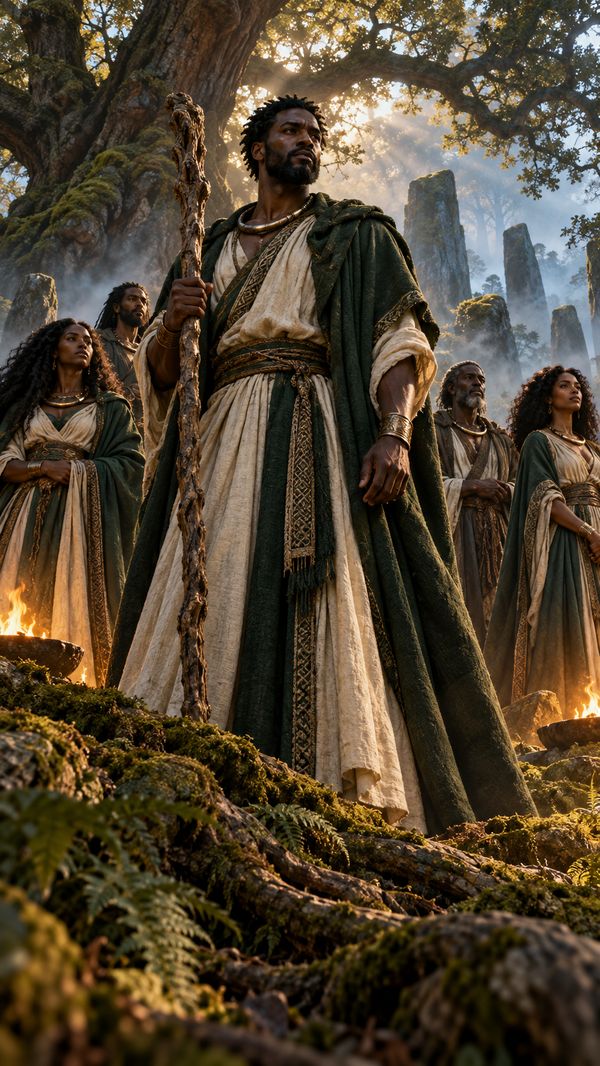
Who Were the Druids? "Dark-Skinned, Curly-Haired Iberians"
Forgotten empires. Erased rulers. Untold history.
When most people picture a druid, mainstream history gives them a formula: an old white-bearded man in a flowing white robe, standing beneath an oak tree.
Scottish scholar David MacRitchie read the actual primary receipts, and found a completely different truth.
In his landmark 1884 work, Ancient and Modern Britons, MacRitchie pulled from the oldest recorded descriptions of the priesthoods in Britain and Brittany. What he uncovered shatters the modern myth. Here is the historical record, in MacRitchie's own words.
"Swarthy of Colour, Had Curly Hair"
MacRitchie zeroes in on the Iberians, a foundational population spanning the British Isles, including powerful tribes like the Silures and Damnonii:
"Physically, they were swarthy of colour, had curly hair, and were bearded like goats. They, or some clans of them, 'worshipped the gods,' and 'both men and women professed a knowledge of the future.'" Vol. I, p. 44
He doesn't mince words. He connects this dark-skinned population directly to the sacred priesthood itself. The Druids and Druidesses, he concludes,
"...were dark-skinned, curly-haired Iberians, of the tribe of the Silures or Damnonii? This seems a fair inference." Vol. I, p. 44
Black Garments on Anglesey
When Roman general Suetonius marched his legions against the sacred island of Anglesey, the priesthood charged out to defend their sanctuary. MacRitchie quotes the Roman record of that clash:
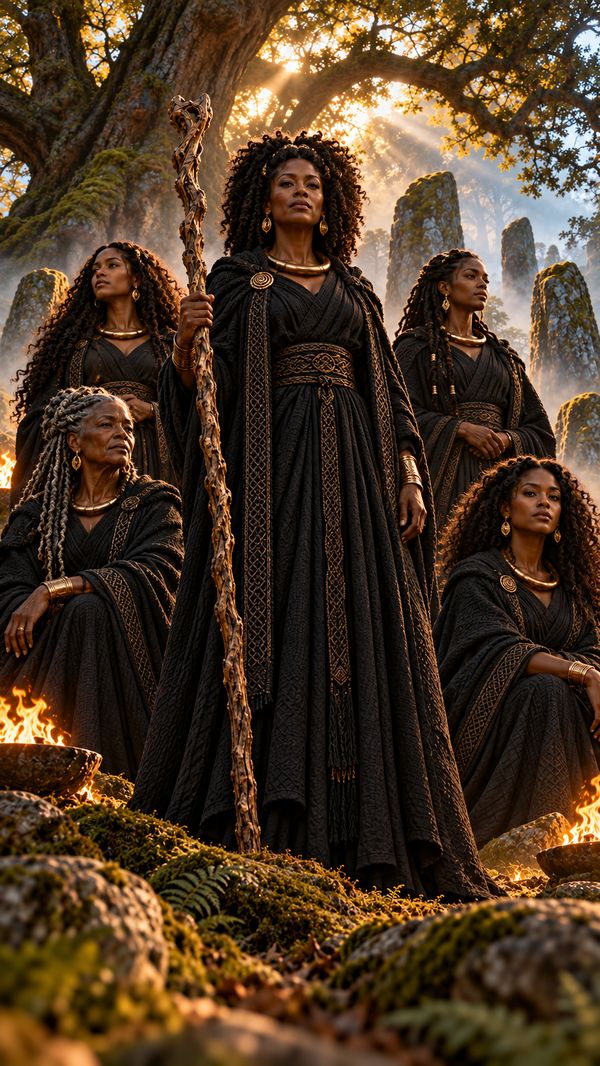
"Arrayed in black garments, they ran wildly to and fro, with dishevelled hair and drawn swords" Vol. I, p. 44
Tracing this physical line across the ancient world, MacRitchie notes that this dark dress was a shared cultural standard:
"Here again, the black dress is seen to be common to the Lusitanians, to the people of the Cassiterides, and to the Druidesses of Anglesey. And if, as may be reasonably supposed, all these belonged to the same swarthy race..." Vol. I, p. 45
He reinforces this lineage in Volume II:
"If those Scotch bishops and abbesses were attired in black garments, so were the Druids and Druidesses of Anglesey and Brittany." Vol. II, p. 293
The Gaelic "Black Art"
MacRitchie highlights that the ancient Gaelic language itself encoded this dark reality into the very terminology for magic:
"The 'black art' (dubh-chleasachd) of the conjurers and 'magicians' (druidhean) of Early Britain, was regarded by Pliny as almost identical with that practised by the magi of Persia." Vol. II, p. 119
The "Moorish" Magi
Stripping away centuries of historical rewriting, MacRitchie calls these priests the "Pictish Magi" and frames Saint Columba's northern mission for what it actually was: an all-out campaign against an indigenous priesthood:
"It is more than thirteen hundred years since Columba began his campaign against the paganism of the 'Moorish' Magi (or Druids)" Vol. II, p. 279
Godfrey Higgins, author of Anacalypsis, traced the same priesthood east. In The Celtic Druids (1827) he wrote:
"All this tends to place beyond doubt the fact, that the Druidical system and that of Persia and India were the same..." Godfrey Higgins, The Celtic Druids, p. 179
"...a very intimate relation, and probably correspondence, existed in those days amongst the priests, of whom the Druids were a part, from India to Thule." Godfrey Higgins, The Celtic Druids, p. 278
And he described the god of those eastern priests, the Budda whose followers he linked to the druids, plainly:
"Budda with his flat black face and curly head, as yet seen in the temples, preceded Brahma by a long series of years." Godfrey Higgins, The Celtic Druids, p. 65
Where Did the Druids Go?
MacRitchie argues that these priests were never wiped out. Their influence was simply absorbed. Their traditional black robes survive to this day in executive, legal, and academic dress:
"There is no reason, except that of inherited custom, why black should be regarded as peculiarly appropriate to clergymen, doctors, lawyers, and other representatives of the druidical system" Vol. II, p. 292
"The highest and noblest attributes of Druidism are to be found in our schools, and universities and churches." Vol. I, p. 149
Higgins found the same survival in the early Scottish church:
"...when Columba came to Iona, he found some Druids who opposed him, and who disguised themselves in the habit of monks. All this tends to shew, that the Culdees and the Druids were the same; that the Culdees were, in fact, Christianized Druids." Godfrey Higgins, The Celtic Druids, p. 204
In 1910, MacRitchie traced where they lived:
"...the druids of the British Isles were a caste of magic-workers, not very different from Lapp shamans, whose permanent homes were chambered mounds and souterrains." David MacRitchie, "Druids and Mound-Dwellers," The Celtic Review, 1910, p. 272
Closing with a sweeping historical horizon, MacRitchie writes:
"To find a period at which castes of swarthy Magi, Druids, and Soothsayers (akin to those of ancient Assyria, Persia, and Egypt) did not inhabit the West of Europe, inclusive of the British Islands, we must look far beyond the period of Caesar's conquests." Vol. II, p. 352
See the Evidence Yourself
🎬 Watch the History Unfold
Watch: The Legendary Power of the Druids, Keepers of Ancient Secrets
📜 Read the Original Scans
Don't take our word for it. Examine the primary sources yourself:
- Read Volume I on Archive.org (Start on page 44)
- Read Volume II on Archive.org
- Read Godfrey Higgins, The Celtic Druids, on Archive.org
- Read MacRitchie, Druids and Mound-Dwellers, on Archive.org
Hit reply and let us know: Did the druids look the way you were taught in school?
Keep the Receipts Coming
The Swarthy Channel is 100% independent and viewer-supported. Mainstream narratives won't cover these primary sources. It takes our community to bring erased history back to light.
Subscribe to The Swarthy Channel for more forgotten empires, erased rulers, and untold history.
- Official Site: www.theswarthychannel.com
Sal Austin
The Swarthy Scroll
This is The Swarthy Channel!
If this work matters to you, join the $1 Swarthy Circle. One dollar a month keeps this channel independent. Join on Patreon
If you enjoyed this, share it with another history lover.